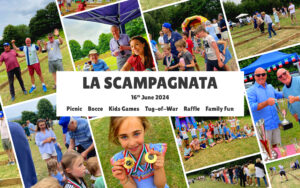
Over for another year, the Scampagnata was a great success with beautiful weather and a fun day for all. See some of the pictures below and feel free to send any of your own in for us to put online!
Thanks to all who came, see you at our next event!
Original Post:
It’s that time of year again… dust off your deckchairs for the annual Scampagnata!!! Held on Fathers Day, 20th June, the Scampagnata is always a fun filled day for the whole family. With bocce, sports, bouncy castle and more, there is never a dull moment. Mass will be at 12:30pm.
Location: Belmont Abbey, Hereford
Date: Sunday 20th June
Each Summer the Welsh (and English and American) -Italians take time out of their busy schedules and return to Bardi. With more bars per square inch than San Antonio, Ibiza, festas like Festa del Imigrante or bands like Jam with Robina playing, there is always something to do.
Here are some pictures of Bardi and the surrounding villages taken by Delucia Sidoli during her Summer there.
31 maggio – E arrivato, ospite di Bardi, per tre giorni, proveniente da Montidelli dove ha tenuto il suo primo spettacolo nella chiesa di San Donnino Martire nella serata del 30, il famoso CORO MASCHILE DI CWMBACH GALLES che si e esibito, in serata, nella sala germitissima dell’auditorium di San Francesco. Il primo giugno poi hanno cantato all’Eucaristia della Santa Messa e hanno reso omaggio ai caduti del l’Arandora Star nel momento della cerimonia del Ricordo nel nostro cimitero. Nel primo pomeriggio poi si sono trasferti a San Remo dove in serata hanno concluso la loro tournee italiana. Speriamo di averli ancora graditi ospiti in un prossimo avvenire.
Pictures from the event…
By Mario Basini
Location: Liverpool, England
Along with thousands of others in Italian families throughout Britain, part of my mother died beneath the cold waters of the Atlantic one grey morning in July 1940. She had arrived in Wales 16 years before, a wild-eyed peasant girl from the hamlet of Pietranera on the road north from Bardi, then in the Province of Piacenza, to Boccolo dei Tassi. She had come to help her brothers and their wives run the family’s series of cafes, fish and chip shops and grocery stores in the upper Rhondda Fawr. By the outbreak of World War II, she was a handsome woman in her early forties, still unmarried and apparently happy to remain a career business woman.
She, her three brothers – a fourth spent most of his time in Italy running the family farm – and their families had found themselves a place in the hearts of their Welsh neighbours. Sixty years after she had moved from the Rhondda to Merthyr Tydfil to start her own family, people in Trehebert and Tynewydd remembered her with affection. But in a few short hours in June, 1940, that relationship and much of the business the Basinis had spent decades creating had been destroyed.
On June 10, Mussolini in a long, ranting speech from the balcony of Rome’s Palazzo Venezia declared war on the UK. In an instant, Britain’s Italian community, perhaps 18,000 strong, became “enemy aliens” to be treated with suspicion, sometimes reviled and their property attacked. Anti-Italian riots broke out in cities including Swansea, Cardiff and Newport and in parts of the Rhondda.
At dawn the next morning the waves of arrests of Italian males destined for internment began. Four thousand two hundred were taken, 300 of whom were British citizens. Among those who were still Italian were my father, then a widower in Merthyr Tydfil struggling to bring up three young children, and two of my mother’s brothers. The eldest, my uncle Giuseppe, Jack, and my father, Marco – another Basini – were lucky. They were interned for a few brief months on the Isle of Man before the authorities realised the absurdity of their decision and sent them home. My mother’s youngest brother, her beloved Bartolomeo, Bert, had no such luck. Aged 31 and startlingly handsome with huge brown eyes and a winning smile, he had married gentle, gracious Anna, from the village of Grezzo, two miles down the road from Pietranera. Their twins, Johnny and Mary, had been born the previous November. Caught up in a process that even British politicians and civil servants at the time labelled unjust and “chaotic”, he found himself among 1500 Italians destined for interment camps in Canada. The list was supposed to contain “the desperate characters” representing a particular danger to Britain.
The selection process was hopelessly bungled by the British security service, MI5. Its criterion for determining whether an Italian represented a significant risk to Britain was membership of the “fascio”, a series of clubs set up around the country by Mussolini’s government. But for many, anxious to protect their families and property back home in Italy, membership of the fascio was obligatory. In most cases membership was merely an expression of a patriotism and pride in Italian culture. While convinced fascists remained at home unmolested, famous anti-fascists were earmarked for deportation. When the authorities arrived at their camps to pick them up, many of those not chosen swapped places with others on the list in order to remain with brothers, fathers, sons, uncles. Some were victims of mistaken identity. When nowhere near the intended 1500 could be found, people were plucked at random from the camps.
The Arandora Star, a luxury cruise liner converted for war use, sailed from Liverpool for Canada early on July 1, 1940. It carried 478 Germans and Austrians as well as around 250 escort soldiers and 180 crew members. By far the biggest contingent was the estimated 712 Italians, most, like my uncle, entirely innocent café proprietors, waiters, fish and chip shop owners. At around 7am the following day it was sited and sunk by a German submarine, U- 47, 125 miles off the northern Irish coast. One hundred and seventy five Germans and Austrians died, 58 crew and 91 soldiers. The Italians bore the brunt of the tragedy. Around 446 died, more than 60 per cent of those on board. Among them was my uncle Bartolomeo.
For those they left behind it was the beginning of a lifetime’s pain. Overwhelmed by feelings of loss and confusion, their grief was deepened by the British government’s callous indifference. Families were informed of their loved ones’ fate by a perfunctory telegram sent many weeks after the sinking. Their healing was impeded by the fact that for most there could be no funeral and the closure that comes with it. Almost none of the few bodies recovered could be identified. The resounding silence in which the British government shrouded the tragedy continued after the war. The Arandora Star and its victims had, for all intents and purposes, been consigned to oblivion.
For those most intimately affected – wives, sons, daughters, brothers, sisters grandchildren- this lack of recognition meant that they have since lived in a limbo of loss and frustrated emotion. “It is as if we have been wrapped in a thick fog,” explains Mary, Bartolomeo’s daughter, now living in Bridgend. For the rest of her life my mother cried when she remembered her baby brother.
At last, things have begun to change and official recognition of their loss has begun. On June 30 a day of remembrance was held on the Scottish island of Colonsay where some of the bodies and wreckage from the Arandora Star washed up in 1940. A memorial to those who died was unveiled there three years ago. On July 2, the 68th anniversary of the sinking of the Arandora Star, Liverpool, the port from which the ship sailed, hosted a series of events to commemorate its victims. A moving service at Our Lady and St Nicholas, the “sailor’s church” was addressed by the Most Reverend Mario Conti, Archbishop of Glasgow who also unveiled a plaque that will eventually stand on the Pierhead at Liverpool. The Italian ambassador, H.E. Dr Giancarlo Aragona, read from The Book of Wisdom. A representative of the German Embassy read from the First Letter of John. The Lord Mayor of Liverpool, Councillor Steve Rotheram, also attended.
Among the most moving aspects of a memorable service was the contribution of the superb Cwmbach Male Choir who held the congregation spellbound. The presence of the choir at the service and the ceremonies that followed was an indication of the particularly heavy price the Italians of South Wales- especially those from Bardi- paid in the tragedy. Representatives of the provinces of Parma, Piacenza and Lucca, where many of the victims originated, also attended. The service was followed by a buffet lunch and the launch of a new book, by Maria Serena Ballestracci who is rapidly becoming the most important historian of the tragedy.
But the highlight for the relatives was a ceremony on the River Mersey at the spot where many of the internees would have had a final glimpse of the famous Liverpool shoreline as the ship steamed for the open sea. Wreaths in memory of the German, Austrian and British victims, as well as one for the Italians, were laid on the water.
At the dinner in the evening a moving speech from Graziella Feraboli, the daughter of victim, Ettore Feraboli, summed up what the day had meant for the loved ones. “It is as if the door of a tomb had at last been opened and some light let in.”
* Relatives of victims who wish to have the names of their loved ones entered in a Book of Remembrance for those who died at sea can contact the Church of Our Lady and St Nicholas, Liverpool’s Parish Church where the book is kept.
By Dino Carpanini
Location: Belmont Abbey, Hereford, England.
Who said the Sun always shines on the righteous, as a grey morning greeted the early morning arrivals at Abbey of the committee members of the Amici Val Ceno for the annual Scampanagta. They soon got down to setting up the Boce` Rinks and various other tasks needed for the children’s sports. As midday approached the weather took a turn for the better with bright sunshine and a slight breeze.
Mass as usual was celebrated in the Abbey which was followed by the customary family picnic on the field. Gone are the days of just a blanket on the ground and a picnic of salumi con fiasco di vino nostrano ! Now it is all systems go with sun canopies, garden umbrellas and accompanying furniture. Table and chairs with the table displaying Italian fare which would do justice to any Trattoria, especially with the Michelin Star quality of the Torte Dolce!!
The afternoon entertainment kicked off with the, or should I say bowled off with the ever popular Boce competition 32 teams took part. The children’s sports, a father’s day race and a grand tug of war, with not only children taking part but also parents, aunts and uncles and anyone who could add weight to the event.
With the sunset the Boce` competition reached its conclusion, and once again last year’s winners were victorious, Eileen Peter from Telford in Shropshire in laws of Basini Gazzi. The runners up were John Carpanini and his nephew Alexander Carpanini.
Thus ended another successful Scampanagta, with many old friendships being renewed and new acquaintances being made. Attendance figure was up on last year, sincere thanks to everyone for they support and generosity in making this such a successful day.
For the friends of the AVC and their families who have not experienced this annual event please try and come along and join us next year to enjoy this really unique social gathering. Any further information regarding this or any other AVC events can be obtained on our website.
A special thanks to Gianluigi Fecci, Paul Guy & Alessandro Strinati for organising the Children’s Sports.
The Pictures
One A.V.C.’s much loved pasta evenings at the Maes Manor Hotel, Blackwood, Wales. This years A.V.C. pasta and disco night was a hugh success. We were pleased to see lots of new (young) faces amoungst the guests. We hope everyone who came had as lovely an evening as we did.
This years annual Maes Manor dinner and dance was a great success. This might have had something to do with the fact that the fantastic Jam with RoBina were performing!
Jam with RoBina a.k.a. Mark Tambini and Romano Marenghi performed live on the night and copies of their self produced debut album Visions of a Runic were available to those who wanted to help support them!
Visit Jam with RoBina’s MySpace page at: www.myspace.com/jamwithrobina or on Facebook at www.facebook.com/pages/Jam-with-RoBina/8731118090. Read more about them at the BBC Wales Music site.
The Pictures
The annual fancy dress party was another great success! This years theme: 80′s ROCK AND POP LEGENDS was adopted by all. Live Music was provided by Jam With RoBina and The Rock Pirates. Dressing up was compulsory.
Tickets were available from Louise Tambini, Paul Tambini, Mark Tambini, Simon Servini, Christian Servini, Romano Marenghi and Gerard Opel.
Thanks to all who came and roll on next year!
The Pictures
A canal boat cruise with buffet aboard the Dragonfly Canal Boat. 2 1/2 hours spent cruising some of the most beautiful scenery lying withing the Brecon Beacons National Park in Wales.